Skip to content

What Will Define Data Centers in 2026?
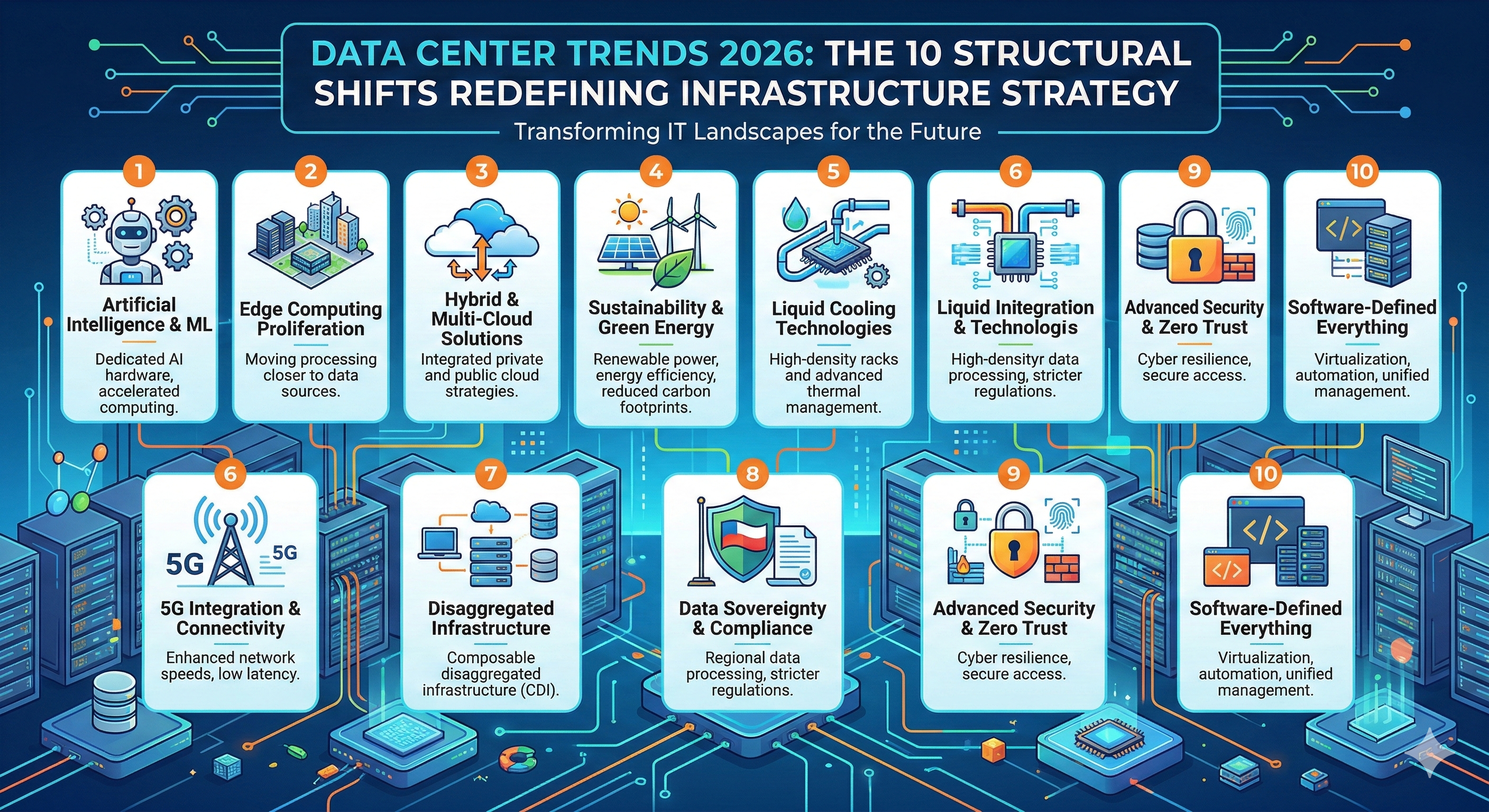
The most important data center trends in 2026 are not incremental upgrades — they are structural shifts.
The ten defining trends are:
- AI-native infrastructure becomes standard — High-density GPU clusters require engineered power, cooling, and network architectures from day one
- Power availability becomes the primary growth constraint — Grid capacity limits expansion across APAC faster than demand
- High-density cooling moves from pilot to production — Liquid-assisted and hybrid cooling systems become mandatory for AI workloads
- Modular expansion replaces monolithic builds — Phased deployment reduces capital lock-in and accelerates time-to-capacity
- Facility and IT operations converge — Unified observability platforms integrate electrical, thermal, and compute telemetry
- Zero Trust becomes embedded in infrastructure fabric — Micro-segmentation and encrypted east-west traffic protect internal workloads
- APAC becomes a strategic orchestration zone — Cross-border infrastructure strategies optimize for latency, regulation, and energy access
- Sustainability shifts from reporting to engineering — Energy efficiency becomes an architectural outcome, not a compliance metric
- Talent shortages reshape operations — Automation and integrated service models compensate for specialized skill gaps
- Capital allocation models evolve toward flexibility — Hybrid ownership and strategic partnerships replace monolithic capex
In 2026, the data center is no longer just a facility. It is a strategic growth engine.
Why 2026 Represents a Structural Break
Between 2015 and 2022, enterprise infrastructure conversations focused on virtualization, hybrid cloud adoption, uptime guarantees, and cost efficiency.
In 2026, the conversation fundamentally changes.
Infrastructure leaders now prioritize:
- AI compute density — Supporting 40kW-100kW+ racks instead of traditional 5-8kW densities
- Energy resilience — Architecting around grid constraints and volatile energy pricing
- Grid capacity constraints — Planning expansion within utility allocation limits
- Cross-border infrastructure orchestration — Distributing workloads across India, Singapore, Malaysia, and broader APAC
- Observability-driven operations — Real-time telemetry replacing reactive maintenance
- Data sovereignty — Regulatory compliance embedded into geographic architecture
This is not modernization. It is architectural reinvention.
Organizations that integrate facility design, IT infrastructure, security architecture, and lifecycle management under one cohesive strategy gain structural competitive advantage.
1. AI-Native Infrastructure Becomes the Default
What Is an AI-Ready Data Center?
An AI-ready data center is purpose-engineered to support:
- High-density GPU clusters — Concentrated compute power generating 10-20x traditional heat output
- Scalable electrical distribution — Modular power systems supporting 50kW-100kW+ per rack
- Advanced thermal management — Liquid cooling, rear-door heat exchangers, or hybrid systems
- Low-latency network fabrics — Spine-leaf architectures with 100Gbps+ interconnects
- Modular expansion capacity — White space designed for iterative scaling
Traditional enterprise environments cannot “bolt on” AI capability at production scale. Density, cooling, and power must be architecturally integrated from initial design.
Architectural Shifts in 2026
Infrastructure requirements have fundamentally changed:
- Spine-leaf networking architectures replace hierarchical core-distribution-access models
- 40kW-100kW rack power densities become standard for AI workloads (versus 5-8kW traditional)
- Rack-level monitoring and telemetry enable real-time thermal and electrical visibility
- Flexible white space design supports mixed traditional and high-density zones
AI is no longer experimental infrastructure. It is production-critical.
This requires integrated expertise across electrical engineering, thermal management, network architecture, and deployment orchestration — not siloed vendor relationships.
2. Power Strategy Becomes a Board-Level Variable
Power availability is emerging as the single largest constraint on data center expansion.
Grid Capacity Realities Across APAC
India:
- Urban metros face utility allocation delays of 18-36 months
- Industrial power contracts compete with data center demand
- Renewable energy mandates reshape procurement strategy
Singapore:
- Government moratorium on new data center builds (lifted selectively for high-efficiency designs)
- Energy pricing volatility impacts operational forecasting
- Power density optimization becomes competitive differentiator
Malaysia:
- Cyberjaya and Johor emerge as energy-advantaged corridors
- Grid modernization supports greenfield development
- Strategic location for enterprises diversifying from Singapore
Strategic Power Approaches in 2026
Leading operators are investing in:
- Advanced UPS topologies — Lithium-ion and flywheel systems replacing traditional VRLA batteries
- Intelligent power distribution — Rack-level metering and automated load balancing
- Energy storage integration — Battery systems providing grid arbitrage and resilience
- N+1 and 2N redundant design — Engineered for resilience across critical workloads
Energy is no longer a facilities procurement issue. It is a strategic growth constraint.
Organizations that architect power strategy at the board level — treating it as infrastructure roadmap rather than operational overhead — achieve greater expansion flexibility and competitive positioning.
3. High-Density Cooling Goes Mainstream
AI workloads generate 10-20x the thermal output of traditional enterprise compute.
Air cooling alone cannot economically manage densities beyond 15-20kW per rack at scale.
Cooling Evolution in 2026
The transition from experimental to production:
- Liquid-assisted cooling adoption expands — Direct-to-chip and immersion cooling move from hyperscale pilots to enterprise deployment
- Rear-door heat exchangers scale — Passive cooling at the rack level reduces facility CRAC/CRAH load
- Hybrid cooling models become standard — Zones designed for mixed air-cooled and liquid-cooled infrastructure
- Hot/cold aisle containment optimization — Improving traditional cooling efficiency before transitioning to liquid
The fundamental shift: Cooling strategy is embedded into facility design upfront, not retrofitted reactively.
Cooling architecture, power distribution, and white space planning are now integrated design decisions — not sequential procurement phases.
Why This Matters
Organizations deploying AI workloads without engineered cooling systems face:
- Thermal throttling reducing compute performance
- Premature hardware failure from sustained high temperatures
- Energy inefficiency from over-provisioned air cooling compensating for design gaps
- Expansion constraints when legacy cooling cannot scale to future density
4. Modular & Phased Expansion Models
What Is Modular Data Center Design?
Modular architecture enables incremental, capital-efficient scaling:
- Incremental capacity deployment — Adding power, cooling, and white space in strategic phases
- Prefabricated power modules — Factory-assembled electrical distribution reducing on-site construction time
- Scalable white space pods — Containerized or modular builds deployed as demand materializes
- Faster time-to-capacity — 6-12 month deployment versus 24-36 month monolithic builds
Why Modular Matters in 2026
Instead of building 10-year capacity upfront (with capital locked into underutilized infrastructure), organizations expand in demand-aligned phases.
This approach:
- Reduces capital lock-in — Investing only in immediately required capacity
- Increases architectural flexibility — Adapting to evolving AI workload requirements
- Accelerates deployment velocity — Modular components deploy faster than custom builds
- Aligns with AI demand cycles — Supporting rapid scaling without stranded assets
Modular design is particularly strategic in rapidly evolving AI infrastructure markets where density requirements, cooling technology, and power architecture continue advancing.
5. Convergence of Facility & IT Operations
What Is Data Center Observability?
Data center observability integrates real-time telemetry across traditionally siloed domains:
- Electrical systems — UPS status, power consumption, load distribution, circuit health
- Cooling infrastructure — CRAC/CRAH performance, temperature differentials, humidity levels
- Network performance — Bandwidth utilization, latency, packet loss, congestion
- Compute clusters — GPU utilization, memory allocation, job queues, thermal output
- Environmental metrics — PUE tracking, energy efficiency, carbon intensity
The Operational Shift in 2026
In 2026, infrastructure dashboards and IT dashboards converge into unified observability platforms.
This integration enables:
- Predictive maintenance — ML models forecasting equipment failure before outages occur
- Real-time failure alerts — Automated escalation when thresholds breach
- Capacity forecasting — Projecting power, cooling, and white space requirements based on utilization trends
- Automated remediation — Self-healing infrastructure adjusting cooling, load balancing, or workload migration
The data center transforms from a static facility into an intelligent, self-optimizing operational environment.
Why This Matters
Organizations maintaining siloed facility teams and IT teams lose operational visibility, efficiency, and response speed. Converged operations reduce mean-time-to-resolution (MTTR) and enable proactive infrastructure management.
6. Zero Trust Moves Inside the Data Center
Security architecture no longer stops at the network perimeter.
The Internal Threat Reality
AI workloads dramatically increase east-west traffic (internal server-to-server communication), creating new attack surfaces:
- Lateral movement risks — Compromised workloads accessing adjacent systems
- Data exfiltration — Internal traffic leaving the facility without encryption
- Insider threats — Privileged access exploiting flat network architectures
- Supply chain vulnerabilities — Third-party integrations lacking segmentation
Zero Trust Architecture in 2026
Zero Trust principles now embed directly into data center infrastructure:
- Micro-segmentation — Network policies isolating individual workloads or rack zones
- Encrypted east-west traffic — TLS/mTLS for internal communication, not just external
- Secure remote console management — Multi-factor authentication and session recording for infrastructure access
- Integrated network-security design — Firewalling, intrusion detection, and access control embedded at deployment
Zero Trust is architected into infrastructure design — not retrofitted as a compliance afterthought.
Why This Matters
As AI models become business-critical intellectual property, protecting internal infrastructure from lateral threats becomes as important as perimeter defense.
7. APAC Becomes a Strategic Infrastructure Zone
Asia-Pacific is evolving from a deployment region into a strategic orchestration zone for global enterprises.
Regional Infrastructure Dynamics
India:
- Hyperscale expansion continues — Mumbai, Chennai, Hyderabad as primary hubs
- Renewable energy mandates reshaping power procurement
- Data localization regulations requiring in-country infrastructure
- Talent availability supporting build-operate-transfer models
Singapore:
- High-efficiency density focus — Government prioritizing PUE optimization over expansion
- Energy pricing volatility driving operational cost forecasting
- Strategic connectivity hub — Subsea cable landing station for APAC-Europe-US routes
- Regulatory maturity supporting financial services and healthcare workloads
Malaysia:
- Emerging growth corridor — Cyberjaya and Johor attracting greenfield investment
- Energy advantages — Lower power costs and grid capacity availability
- Proximity to Singapore — <1ms latency supporting distributed architectures
- Government incentives for data center development
Cross-Border Infrastructure Strategy
Enterprises are designing multi-country infrastructure strategies to:
- Diversify regulatory exposure — Reducing dependence on single-jurisdiction data residency
- Optimize energy access — Locating workloads in power-advantaged regions
- Reduce latency — Distributing AI inference nodes closer to end users
- Support distributed AI training — Leveraging cross-border compute pools
Infrastructure orchestration across India, Singapore, Malaysia, and broader APAC becomes a competitive differentiator in 2026.
This geographic strategy aligns with vendor-agnostic, regionally distributed deployment models.
8. Sustainability Becomes Engineering-Driven
In 2026, sustainability shifts from compliance reporting to architectural engineering.
From Metrics to Outcomes
Organizations move beyond:
- Annual ESG reports → Real-time PUE dashboards
- Carbon offset purchases → Renewable energy contracts
- Green washing → Measurable efficiency gains
Engineering-Driven Sustainability
The focus becomes:
- Energy efficiency improvements — Optimizing cooling systems, power distribution, and workload placement
- Cooling optimization — Transitioning to liquid cooling reducing overall energy consumption
- Lifecycle-aware design — Hardware refresh cycles, e-waste management, circular economy principles
- Intelligent load management — Workload scheduling aligned with renewable energy availability
AI infrastructure growth must be matched with proportional efficiency innovation.
Organizations treating sustainability as an engineering discipline — not a marketing department responsibility — achieve both cost savings and regulatory positioning.
9. Talent & Operational Complexity
High-density, AI-ready infrastructure environments require cross-disciplinary expertise that is increasingly scarce.
The Talent Gap
AI-ready data centers demand:
- Advanced thermal engineering expertise — Liquid cooling system design and management
- Integrated infrastructure management — Facility + IT + security convergence
- AI workload optimization knowledge — GPU cluster tuning, job scheduling, performance monitoring
- Cross-domain coordination — Electrical engineers collaborating with network architects and ML teams
Operational Responses in 2026
Organizations address talent constraints through:
- Automation and AI-driven operations — Reducing manual intervention requirements
- Integrated managed service models — Outsourcing specialized operations to expert providers
- Workforce upskilling programs — Retraining traditional IT teams on AI infrastructure
- Vendor-agnostic partnerships — Leveraging design-build-operate expertise without vendor lock-in
The shortage of specialized talent is reshaping how organizations approach infrastructure operations — accelerating the shift toward managed services and automation.
10. Capital Allocation Evolves
Investment in data center infrastructure remains strong, but capital discipline increases.
Shifting Financial Models
2026 trends include:
- Phased deployment — Incremental capacity reducing upfront capex
- Hybrid colocation models — Mixing owned infrastructure with leased white space
- Flexible scaling agreements — Consumption-based pricing for power and cooling
- Strategic infrastructure partnerships — Design-build-operate models sharing risk and investment
Why Financial Strategy Matters
Infrastructure investment is now financially strategic — not just technical:
- AI demand volatility makes 10-year capacity planning risky
- Technology evolution creates depreciation and obsolescence risk
- Grid constraints limit expansion optionality
- Regulatory changes impact geographic deployment strategy
CFOs and CIOs now collaborate on infrastructure roadmaps, treating data centers as strategic capital allocation rather than IT overhead.
Executive Decision Framework for 2026
CIOs and infrastructure leaders should evaluate their readiness across seven strategic dimensions:
Strategic Assessment Questions
- AI-Density Readiness — Is our facility architected for 40kW-100kW rack densities, or constrained to legacy 5-8kW designs?
- Power Headroom Engineering — Is power capacity engineered for 3-5 year growth, or are we operating at allocation limits?
- Integrated Cooling Planning — Is cooling strategy embedded into expansion planning, or treated as a reactive procurement decision?
- Unified Telemetry — Are facility and IT operations converged under unified observability platforms, or siloed into separate teams?
- Embedded Zero Trust — Is Zero Trust architecture deployed internally across east-west traffic, or limited to perimeter security?
- APAC Geographic Flexibility — Do we have multi-country deployment optionality (India, Singapore, Malaysia), or single-location dependency?
- Engineered Sustainability — Is sustainability an architectural outcome with measurable PUE improvements, or limited to annual reporting?
Organizations answering “yes” across these seven domains gain structural competitive advantage in 2026.
Those with fragmented strategies — treating facility, IT, security, and lifecycle management as independent silos — face escalating operational friction, cost overruns, and expansion constraints.
In 2026, data center infrastructure defines organizational speed, resilience, and scalability.
The Modern Data Center Is:
- An AI compute engine — Purpose-built for high-density GPU workloads and ML training
- An energy strategy platform — Architected around power constraints and renewable integration
- A security fabric — Zero Trust embedded across facility and network layers
- A regional orchestration node — Distributed across APAC for latency, compliance, and risk mitigation
- An intelligent operational system — Self-monitoring, predictive, and automated
The Strategic Imperative
Organizations that integrate design, delivery, deployment, and lifecycle management under one cohesive, vendor-agnostic strategy build infrastructure that scales with business ambition.
Those maintaining siloed procurement, fragmented vendor relationships, and reactive expansion planning face compounding technical debt, stranded capital, and competitive disadvantage.
The data center is no longer a cost center. It is a growth multiplier.
Infrastructure strategy in 2026 determines which organizations lead — and which fall behind.
Frequently Asked Questions
What makes a data center “AI-ready” in 2026?
An AI-ready data center supports 40kW-100kW rack densities through engineered power distribution, liquid or hybrid cooling systems, low-latency spine-leaf networking, and modular expansion capacity. Traditional 5-8kW infrastructure cannot economically scale to AI workload requirements.
Why is power availability the primary growth constraint?
Grid capacity limits across India, Singapore, and Malaysia create 18-36 month utility allocation delays. AI workloads increase energy intensity 10-20x versus traditional compute, making power headroom the bottleneck for expansion — not capital or white space.
How does modular design reduce risk?
Modular deployment aligns capital investment with actual demand, reducing stranded assets from over-provisioned capacity. Phased expansion also allows technology upgrades across deployment cycles, avoiding obsolescence from 10-year upfront builds.
What is data center observability?
Observability integrates real-time telemetry across electrical systems, cooling infrastructure, network performance, compute utilization, and environmental metrics into unified dashboards. This enables predictive maintenance, automated remediation, and capacity forecasting.
Why does Zero Trust matter inside the data center?
AI workloads dramatically increase east-west (internal) traffic, creating lateral movement risks if networks remain flat. Micro-segmentation, encrypted internal traffic, and identity-based access control protect high-value AI models and datasets from insider threats and compromised workloads.
How does APAC infrastructure strategy differ from traditional deployment?
Cross-border orchestration across India, Singapore, and Malaysia optimizes for data sovereignty compliance, energy access, latency reduction, and regulatory diversification — rather than single-location deployment. This geographic strategy becomes competitive differentiation.
Is sustainability engineering or reporting in 2026?
Leading organizations treat sustainability as architectural outcomes (PUE optimization, renewable energy integration, cooling efficiency) rather than compliance reporting. Engineering-driven sustainability delivers cost savings alongside regulatory positioning.